
COURSE NAVIGATION
Lecture 8: Socrates - The Just Man
In the 8th of 17 lectures in his "Civilizing the Barbarians" course, Stepanov's theme is "The Just Man". In this lecture, Stepanov delves into the concept of what it means to be just, and what kind of actions can be considered just or unjust. He references the play "The Trojan Women" by Euripides in order to illustrate the ethical dilemmas related to the invasion of a neutral country, the killing of most of its men, and the selling of its women into slavery. Stepanov raises the parallel question of whether it is worthwhile to save American lives by causing harm to others.
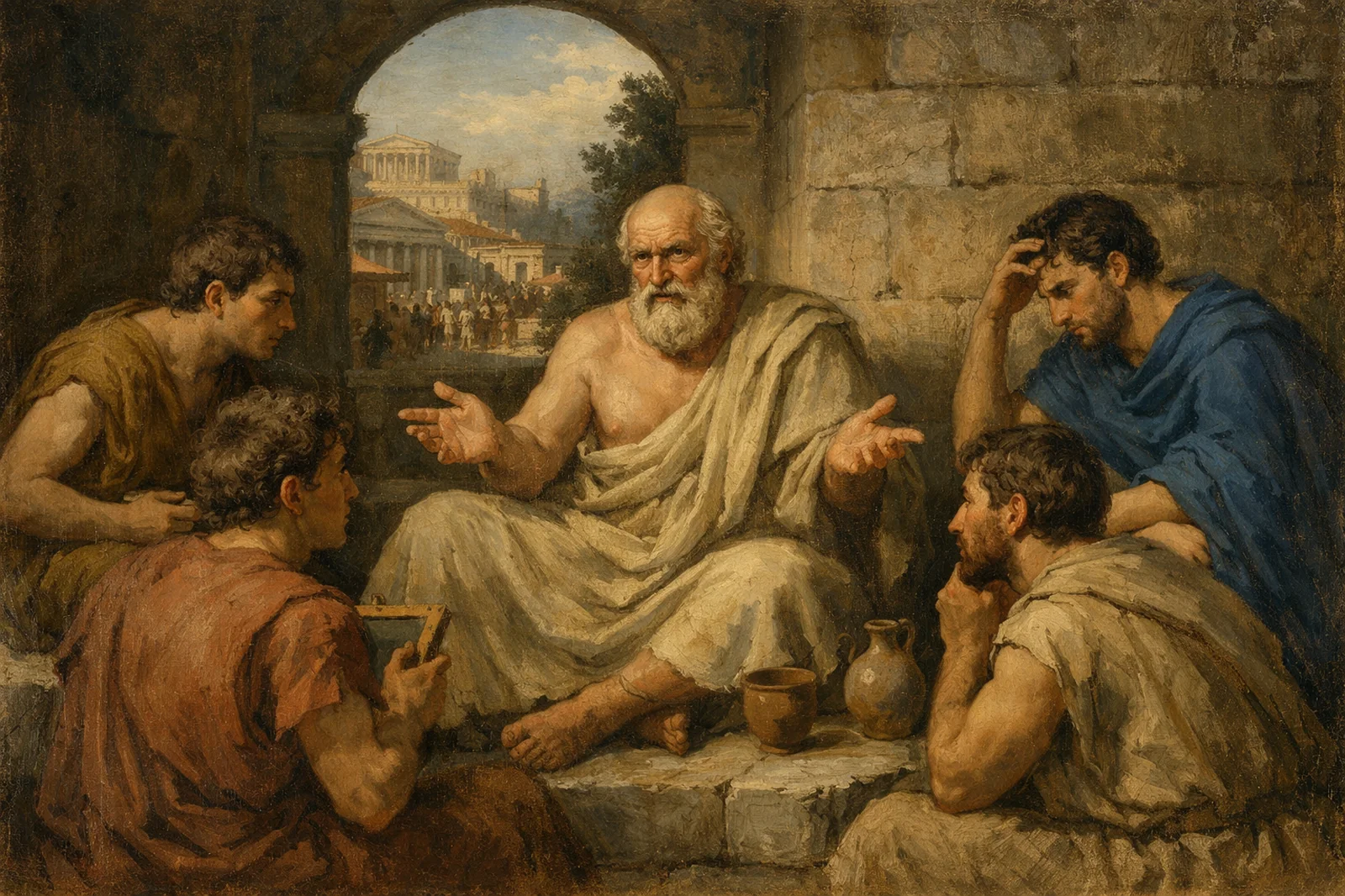
Stepanov then turns his attention to Socrates' physical appearance, opinions, views on justice, and approach to death. He describes Socrates as an unusual person who was poor and physically unattractive, but extremely popular with the elite society of Athens, mostly because of his wisdom and his ability to understand the essence of things. Stepanov mentions how Socrates would publicly say that he's in love with beautiful boys and especially Alcibiades, a famous Greek politician, but it was mostly for their minds and not for their physical aspects. Stepanov also points out that Socrates followed an inner angelic and prophetic voice, which would stop him every time he attempted to do something wrong. When Socrates was found guilty of false charges against him, he did not regret it because he believed that a true philosopher should welcome death since it would allow him to be reunited with the eternal and unchanging Forms, and ultimately to know the truth. Socrates even hoped to meet great figures from the past, such as Homer, in the afterlife.
Despite the fact that Socrates lived in the literate ancient Greek society, much of what we know about him comes from the works of Plato, who was a student of his. Stepanov's short canon contains six of Plato's dialogues: "Symposium," "Apology," "Crito," "Phaedo," "Gorgias," and "Republic." Here is a short summary of the role Socrates plays in each of these dialogues:
| Plato's Dialogue | Role of Socrates in the Dialogue |
|---|---|
| Symposium | Socrates is one of the participants in a dinner party where the guests discuss the nature of love and desire. He listens to the speeches of the other guests and provides his own thoughts on the topic. |
| Apology | Socrates is on trial for impiety and corrupting the youth and he delivers his own defense speech. He uses the opportunity to question the accusations against him, and to expound his own philosophy and moral beliefs. |
| Crito | Socrates is in prison and his friend Crito visits him to urge him to escape. Socrates uses the opportunity to discuss the nature of justice and the obligations of the individual to the state. |
| Phaedo | Socrates is in prison awaiting his execution. He discusses the immortality of the soul and the nature of death with his friends. |
| Gorgias | Socrates engages in a conversation with Gorgias, a Sophist, and others, questioning Gorgias' claim that rhetoric is the highest form of knowledge and that the ability to persuade others is the ultimate goal of the rhetorician. Socrates also examines the nature of justice and the relationship between the individual and society. |
| Republic | Socrates engages in a conversation with various Athenians discussing the nature of justice, the ideal society and the ideal individual. He examines the nature of knowledge and the Forms, and the relationship between the individual and the state. |
Stepanov believes that Socrates's ideas and beliefs are well documented in Plato's works and that it is through these works that we can understand Socrates's views. One of those views is that a just society is one in which citizens should be willing to obey the law even when it goes against their personal interests. Stepanov emphasizes that the just man is not only determined by his actions but also by the integrity of his intentions, and Socrates is a prime example of a just man because of the way he believed in and lived by his principles. Stepanov concludes this lecture with an emphasis that every civilized person should read Plato's dialogues on the death of Socrates, specifically "Phaedo," "Apology," and "Crito." He also mentions that the dialogue in "Republic" is also important in understanding Socrates' demise, as it contains a remarkable passage in which Glaucon argues that talk of justice is meaningless, and uses the example of a just person being subjected to severe punishment, including crucifixion, to make his point.