
COURSE NAVIGATION
Lecture 7: Lessons of History
In the 7th of 17 lectures in his "Civilizing the Barbarians" course, Stepanov introduces the idea of history as a practice by recalling Plutarch's approach to history circa 101 CE and then by introducing his audience to Plutarch's predecessors by over 500 years: Herodotus and Thucydides.
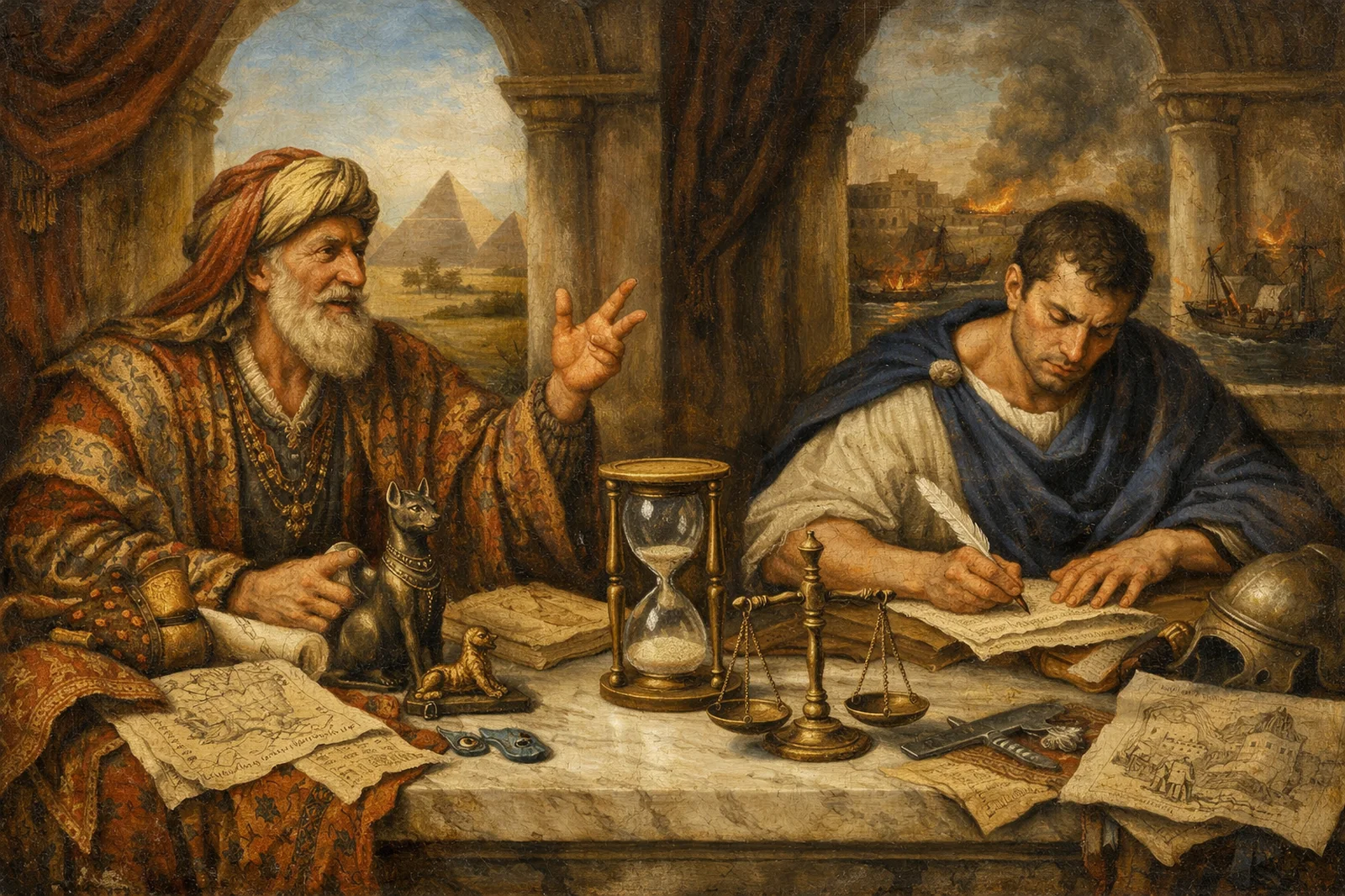
Stepanov refers to Herodotus of Halicarnassus as the first historian and the "Father of History." Herodotus wrote a book called "The Histories" where he aimed to record human events so that they would not fade with time. Stepanov describes "The Histories" as a collection of silly stories, but also notes that it is much more reliable than people used to think. He also mentions that Herodotus described the various places that he traveled to, including Egypt, as well as about the Persian Invasions of Greece including the famous Battle of Salamis in 480 BC.
In contrast to Herodotus, Stepanov calls Thucydides the "Father of Scientific History." Stepanov notes that while both historians were contemporaries, with Herodotus being just 25 years older than Thucydides, their writing styles were very different. Herodotus' work contains more narratives and includes stories and legends, while Thucydides' work is more analytical and focused on the factual details of the long and brutal Peloponnesian War between Athens and Sparta.
As an example of Thucydides' work in "The History of the Peloponnesian War," Stepanov discusses the historical account in which Athens demanded that the small island state of Melos, a Spartan colony, surrender and become part of their empire. Thucydides describes how the Athenians used various arguments, including might is right, to justify their actions, but the Melians refused to surrender and chose to defend themselves. The Athenians ultimately laid siege to the island, killed all the men, and sold the women and children into slavery. Stepanov notes that this event had a profound impact on Athenian society, including on the playwright Euripides, who wrote a play called "Trojan Women" which depicted the plight of women caught up in the devastation of war. The following table shows how close in age Herodotus and Thucydides were to the tragedian Euripides.
| Greek Writer | Born | Age at The Battle of Salamis (480 BC) | Notable Contributions |
|---|---|---|---|
| Herodotus | c. 485 BC | ~ 5 years old | Herodotus, the "Father of History," wrote "The Histories." It is a chronological account of the rise of the Persian Empire, the conflicts between Greeks and Persians and the various historical, social and cultural aspects of the time. |
| Euripides | c. 484 BC | ~ 4 years old | Euripides wrote over 90 plays throughout his career, but only 18 have survived. His most famous works are "Medea," Bacchae," "Hippolytus," and "The Trojan Women." |
| Thucydides | c. 460 BC | Not yet born; born 20 years after the battle | Thucydides, the "Father of Scientific History," is famous for writing "The History of the Peloponnesian War." This work was known for its realism and for being a contemporary account of the war. |
Stepanov concludes his 7th lecture by encouraging his audience to watch a movie called "The Trojan Women." This movie from 1971 is a modern interpretation of Euripides' play by the same name. The movie stars notable actresses such as Christine Hepburn, Vanessa Redgrave, Irene Papas. It was produced by the famous Greek producer Michael Cacoyannis and includes a musical score written by the Greek composer Mikis Theodorakis.