
COURSE NAVIGATION
Lecture 14: The Holy War
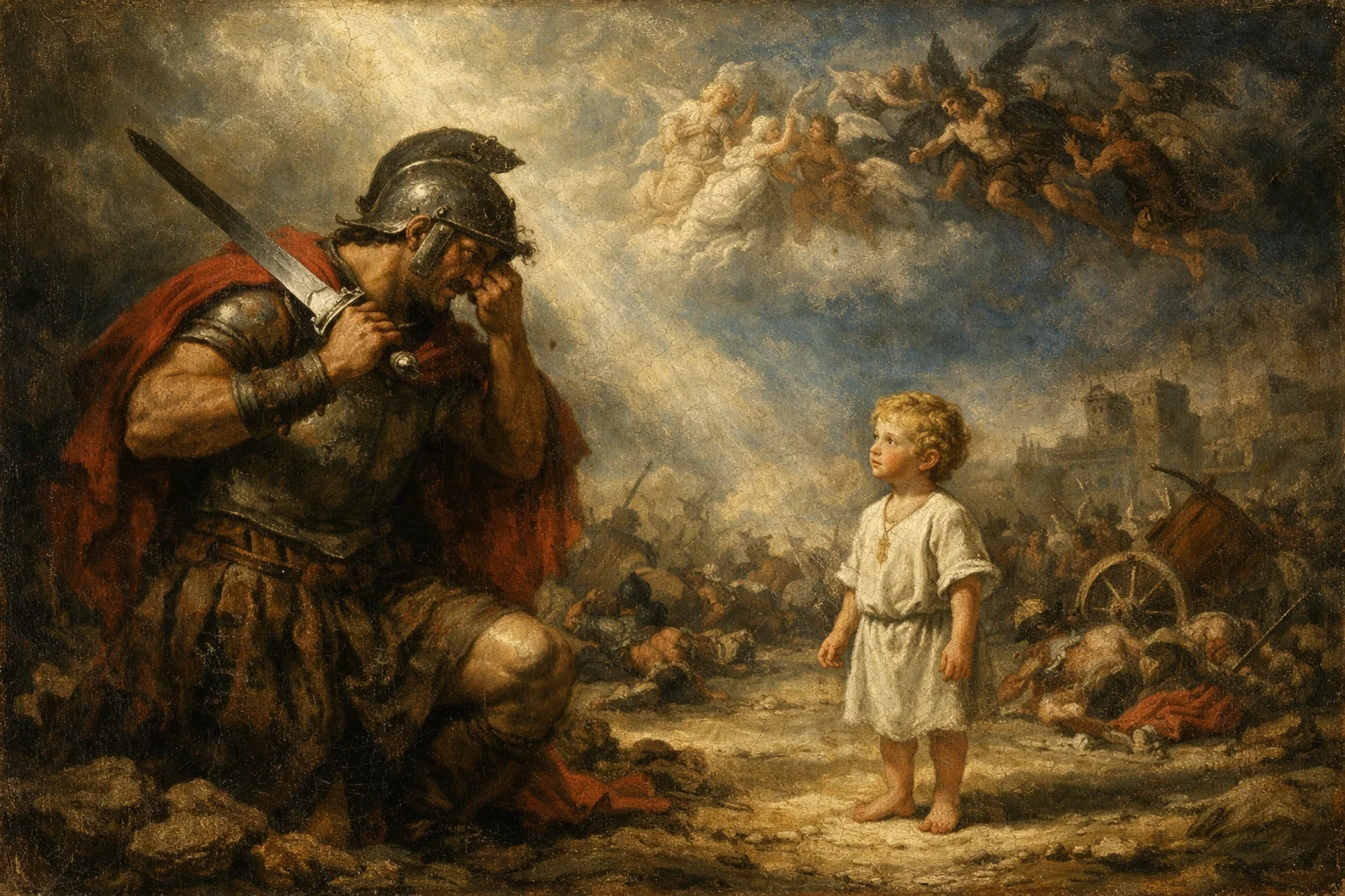
In the 14th of 17 lectures in his "Civilizing the Barbarians" course, Stepanov begins his lecture by posing a question about the relationship between conflict and resources, and whether it is possible for there to be a world without conflict for resources. He references Socrates and Plato, who argue that one should not be willing to kill innocent people for resources. However, Stepanov argues that in extreme cases, such as when an innocent child must be sacrificed for the survival of the world, his position is that the world should end rather than sacrifice an innocent life.
Stepanov addresses the topic of the Bible in his introduction, mentioning how difficult it is to read some of the passages in the Bible and how he was losing sleep while preparing for his lecture on the topic. He mentions how some passages, such as the story of Abraham and Isaac, are difficult to explain and that not everyone has a simple explanation for them. This story is found in the book of Genesis. It tells of God testing Abraham's faith and obedience by asking him to sacrifice his son Isaac as an offering. Abraham is willing to do so, but as he is about to sacrifice Isaac, an angel of the Lord intervenes and stops him, saying that God has tested him and he has proven to be faithful.
Another difficult passage is the story of the extermination of the Jebusites. This story can be found in the book of Joshua. According to the story, Joshua and the Israelites, who were led by God, attacked and defeated the city of Jerusalem, which was inhabited by the Jebusites. The Israelites then killed all the men, women, and children of the city, and destroyed the city and its buildings. This is considered by some as a controversial passage, as it describes the wholesale slaughter of a group of people. Some scholars and religious leaders argue that it is a metaphor for the Israelites taking control of the land, while others argue that it is a historical account of a real event. Stepanov goes on to explain that many theologians throughout history have taken the position that God cannot contradict himself by giving us natural law, which is a universal and objective set of principles that govern human behavior and determines what is right and wrong, and then contradicting it with a command to kill innocent people. Stepanov then explains how the only sustainable moral position is that doing evil is absolutely forbidden, regardless of one's belief in God.
Another topic that Stepanov addresses is the idea of historical context. He mentions the extermination of Native Americans as a terrible thing and notes that the Spaniards who committed atrocities in the New World did not refer to the Bible for justification. He also mentions that there were unjust and totally unacceptable expulsions of the Jews from Spain, England, and a long list of locations, but not exterminations. Stepanov argues that the evidence for this is the survival of the Jews themselves and cites Poland as a place where Jews were welcome for many centuries. Stepanov goes on to say that it is important to read primary sources and not to make assumptions about history.
In conclusion, Stepanov argues that the idea of morality is a difficult concept to grasp and that his position on not sacrificing innocent lives for the survival of the world is not a popular one. He also mentions the importance of historical context and mentions the extermination of Native Americans and the survival of the Jews throughout history. Lastly, he encourages the audience to think about history and to avoid repeating past mistakes.