
COURSE NAVIGATION
Lecture 10: Aristotle - The Universal Knowledge
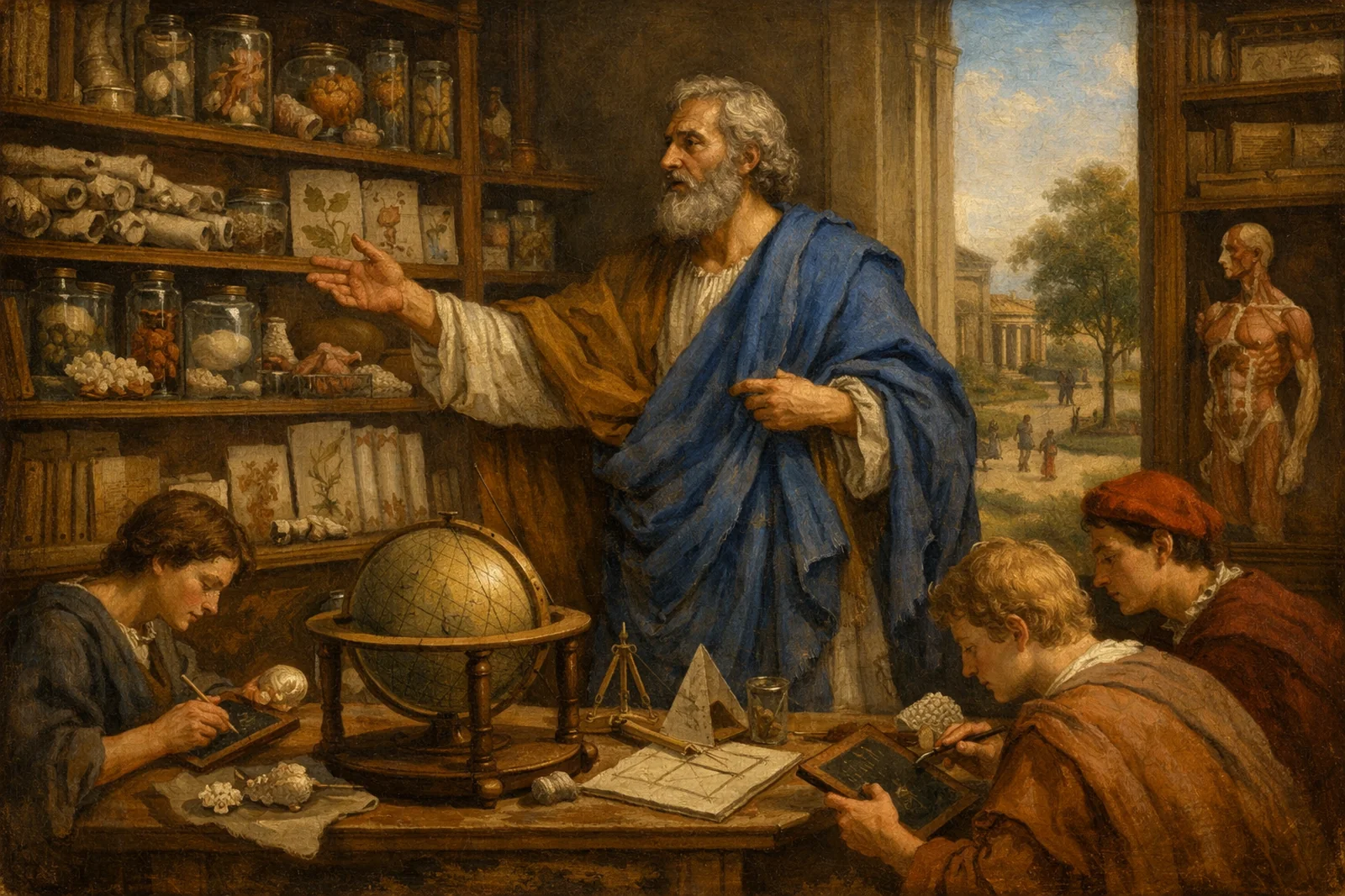
In the 10th of 17 lectures in his "Civilizing the Barbarians" course, Stepanov focuses on the work of Aristotle. He notes that Aristotle's writing is not as beautiful as that of Plato, but his works are still relevant and widely studied even today. He mentions that Aristotle's works are considered to be the first complete encyclopedia of human knowledge, and some of his logical works have not yet been superseded by modern mathematical logic. He also mentions that Aristotle's lectures were recorded by students and some of his works are considered lecture notes, and that Aristotle is credited with starting the modern educational system.
Stepanov then discusses Aristotle's views on money and happiness. He mentions that Aristotle believes that money is not the ultimate goal of ethics and that it does not bring true happiness. He also notes that Aristotle equates certain professions, such as bankers, with pimps and that he has a negative view of their actions.
Stepanov goes on to cover how, in the 13th century, the Catholic Church had a significant influence on the intellectual life of Europe. The church could have rejected Aristotilian thought, but did not. On the contrary, many Christian philosophers and theologians, such as Thomas Aquinas, embraced Aristotelian thought and incorporated it into their own work. Between approximately 1265 and 1273, Aquinas wrote commentaries on many of Aristotle's works such as "Nicomachean Ethics," "Politics," "Metaphysics," "De Anima," "Posterior Analytics," "Categories," "On Interpretation," "On the Heavens," and "On Generation and Corruption." Aquinas believed that there was no conflict between Aristotelian philosophy and Christian theology, and that they could complement each other.
Next, Stepanov discusses some of the great mathematical works of the Greeks, including Euclid's "Elements" and Apollonius of Perga's work on conic sections. He points out that these works are still relevant today and are beautiful in terms of precision and beauty. He also highlights Archimedes' work on calculus and integration, noting that it led to the work of Newton. Additionally, he mentions how Archimedes' result on the volume of a sphere is considered one of the greatest results in the history of mathematics and how it was inscribed on his tombstone. Cicero once visited this tomb, but it is now sadly lost.
Stepanov concludes this lecture by discussing additional scientific accomplishments of the ancient Greeks, and by comparing the Greeks to the Romans. For example, he discusses the Greek's Antikythera mechanism, which was an astronomical device used to predict the positions of planets. Stepanov highlights the remarkable practical abilities of the ancient Greeks, particularly in terms of their advanced understanding and use of gears, which were not rediscovered until the end of the 18th century. He also notes that much of the advanced scientific knowledge of the ancient Greeks has been lost due to the fact that the texts and research materials were only accessible to a small number of scholars, and also due to the fact that new conquerors, like the Romans, did not value this knowledge. Stepanov believes that Romans were not as interested in mathematics as the Greeks were and were more focused on money. Stepanov ends the lecture by emphasizing the importance of preserving what little remains of Western civilization and by encouraging people to read good books and protect what we have left of it.